
 ETF Website



Did You Know
Did You Know
7 things to know about ETF

Investor education infographic titled "Did You Know? ETFs Replicate Index". The infographic explains that Exchange Traded Funds (ETFs) are investment products designed to generate returns similar to an underlying index by typically replicating the index constituents and their respective weightings in the underlying portfolio. The illustration includes a computer monitor displaying stock market charts, bar charts, a pie chart, and a support representative wearing a headset to represent investment tracking and market participation. The infographic advises investors to consult a financial advisor before investing and states that mutual fund investments are subject to market risks and that scheme-related documents should be read carefully.
Myth 1: Did You Know – ETFs replicate index
ETFs are investment products that aim to generate returns similar to the underlying index by typically replicating the constituents and their weight in the underlying portfolio.
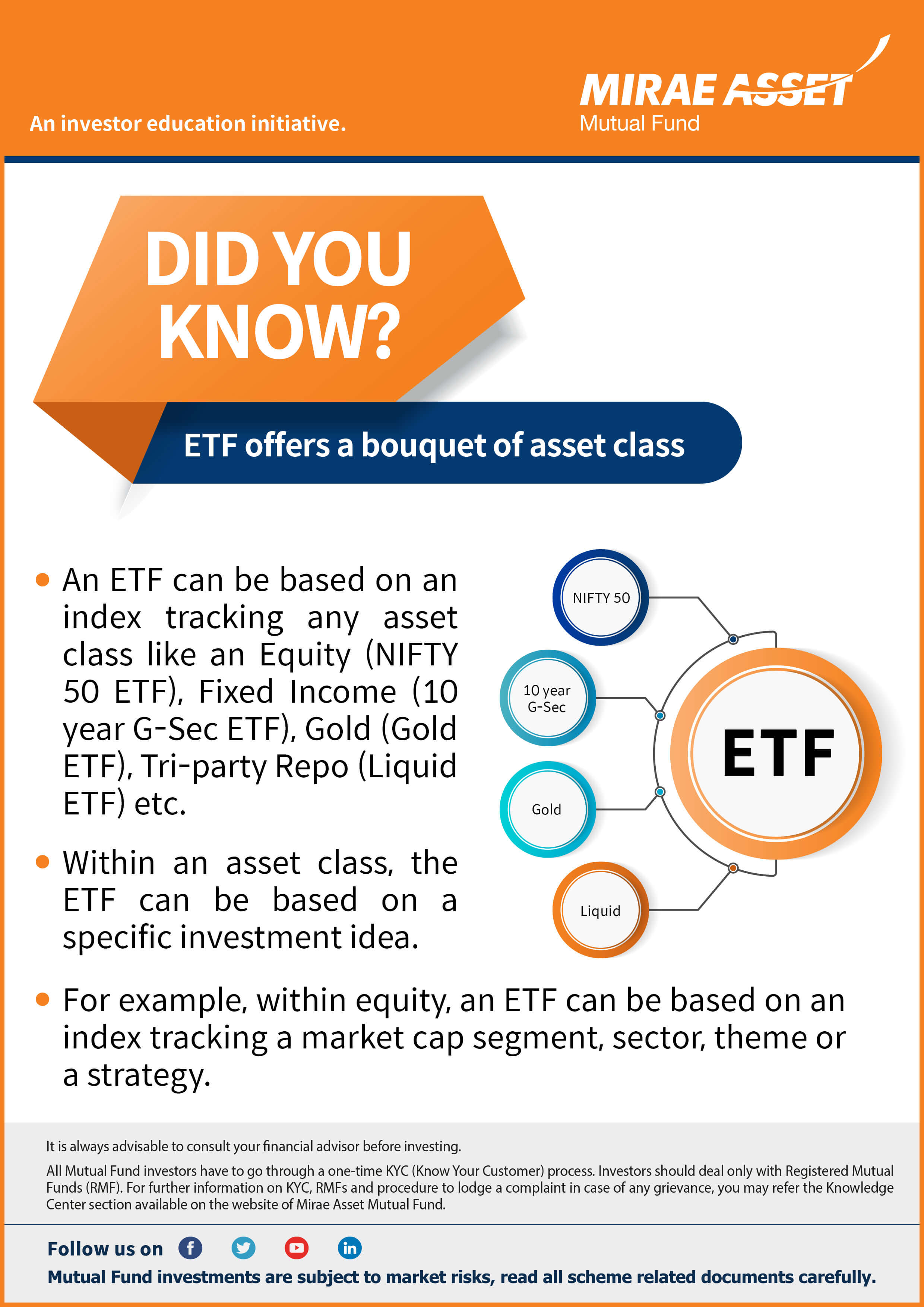
Investor education infographic titled "Did You Know? ETF offers a bouquet of asset class". The infographic explains that an Exchange Traded Fund (ETF) can be based on an index tracking various asset classes, including equity through a NIFTY 50 ETF, fixed income through a 10-year G-Sec ETF, gold through a Gold ETF, and tri-party repo through a Liquid ETF. It further explains that within an asset class, an ETF can be based on a specific investment idea. For example, within equity, an ETF can track a market capitalisation segment, sector, theme, or investment strategy. The illustration shows an ETF connected to examples of asset classes including NIFTY 50, 10-Year G-Sec, Gold, and Liquid. The infographic advises investors to consult a financial advisor before investing and states that mutual fund investments are subject to market risks and that scheme-related documents should be read carefully.
Myth 2: Did You Know – ETF offers bouquet of asset class
An ETF can be based on an index tracking any asset class like equity (NIFTY 50 ETF), Fixed income (10 year G-Sec ETF), Gold (Gold ETF), Tri-party repo (Liquid ETF) etc. Within an asset class, the ETF can be based on a specific investment idea. For example within equity, an ETF can be based on an index tracking a market cap segment, sector, theme or a strategy.

Investor education infographic titled "Did You Know? ETFs are transacted on Stock Exchanges". The infographic explains that ETFs are listed, traded, and settled on stock exchanges in the same way as other stocks. It states that there are buyers and sellers of ETFs on the exchange and that prices are determined based on demand and supply. The infographic further explains that a market maker is appointed by the Asset Management Company (AMC) to provide pricing and liquidity in ETFs around the real-time Net Asset Value (NAV). It also states that ETFs are held in a demat account in the same way as shares. An illustration shows a stock market trading screen with buy and sell indicators representing ETF trading on an exchange. The infographic advises investors to consult a financial advisor before investing and states that mutual fund investments are subject to market risks and that scheme-related documents should be read carefully.
Myth 3 : Did You know – ETFs are transacted on Stock Exchanges
ETFs are listed, traded and settled on the Stock Exchanges like any other stock. There are buyers and sellers of ETFs on exchange and prices are determined based on the demand and supply. A market maker is also appointed by the AMC, to provide pricing and liquidity in ETF on the exchange around real time NAV. ETFs are held in your demat account the same way as you hold shares.

Investor education infographic titled "Did You Know? ETF can be transacted directly with AMC". The infographic explains that ETFs can be purchased and sold in larger quantities, in multiples of the creation unit size, directly with the Asset Management Company (AMC). It also states that the number of units in a creation unit is specified for each ETF by the AMC. An illustration shows people reviewing investment charts and analytics on a large display, representing direct ETF transactions with an AMC. The infographic advises investors to consult a financial advisor before investing and states that mutual fund investments are subject to market risks and that scheme-related documents should be read carefully.
Myth 4: Did You know – ETF can be transacted directly with AMC
ETFs can also be purchased and sold in larger quantities i.e. in multiples of creation unit size, directly with the AMC. The quantum of units in a creation unit size is specified for each ETF by the AMC.

Investor education infographic titled "Did You Know? ETFs usually have a lower expense than active mutual funds". The infographic explains that ETFs generally have lower expense ratios compared to active mutual funds, which may have expense ratios of around 2.25 percent for regular plans. It states that plain vanilla ETFs, such as NIFTY 50 ETFs, are available at an average expense ratio of approximately 0.08 percent, whereas some thematic or specialised ETFs may have expense ratios of up to approximately 1 percent. The infographic notes that expenses may change within the limits prescribed by SEBI Mutual Funds Regulations, 1996, and cites ACE MF as the source. Illustrations compare ETF costs with active mutual fund costs using financial symbols and directional arrows. The infographic advises investors to consult a financial advisor before investing and states that mutual fund investments are subject to market risks and that scheme-related documents should be read carefully.
Myth 5 : Did You Know – ETFs usually have a lower expense than active Mutual Funds
ETFs usually have low expense ratio compared to active mutual funds which may have expense ratio around 2.25%*(regular plan) For example, plain vanilla ETFs like NIFTY 50 ETFs are available at an average of just .08% whereas, a few thematic or exotic ETFs can go as high as ~1%.

Investor educationasses based on a defined methodology. It states that ETFs can cover a range of sector, strategy, style, and size spectrums, enabling investors to build customised investment portfolios consistent with their financial needs, risk tolerance, and investment horizon. The infographic also notes that both institutional and individual investors use ETFs to conveniently, efficiently, and cost-effectively allocate their assets. An illustration shows a segmented circular chart representing different investment categories and portfolio diversification. The infographic advises investors to consult a financial advisor before investing and states that mutual fund investments are subject to market risks and that scheme-related documents should be read carefully.
Myth 6 : Did You Know – ETFs give exposure to a variety of investment segments.
ETFs can provide investors an exposure to various asset classes as per the defined methodology. They can cover a range of sector, strategy, style and size spectrums, enabling investors to build customized investment portfolios consistent with their financial needs, risk tolerance, and investment horizon. Both institutional and individual investors use ETFs to conveniently, efficiently, and cost effectively allocate their assets.

Investor education infographic titled "Did You Know? ETFs provide a similar taxation benefit as Mutual Funds". The infographic explains that the taxation of ETFs is treated in the same way as mutual funds. For equity ETFs, gains are classified as short-term capital gains if the investment is held for less than one year and are taxed at 15 percent. If equity ETFs are held beyond one year, gains are classified as long-term capital gains and are taxed at 10 percent. An illustration depicts taxation and investment concepts using financial symbols and currency icons. The infographic advises investors to consult a financial advisor before investing and states that mutual fund investments are subject to market risks and that scheme-related documents should be read carefully.
Myth 7 : Did You Know – ETFs provide a similar taxation benefit as Mutual Funds
The taxation of ETFs is treated in exactly the same way as equity funds. For example, in case of equity ETF, any gain will be classified as a short term capital gain, if held for less than 1 year and taxed at 15%. If these equity ETFs are held beyond 1 year, then it becomes a long term capital gain and is taxed at 10%.