Bank fixed deposits and Government small savings schemes have been the traditional investment choice of average Indian households. As per Reserve Bank of India’s Quarterly Estimates of Household Financial Assets and Liabilities, Rs 4,753 billion was invested in bank FDs in FY 2018 (latest year for which data is available from RBI). On the other hand, despite its growing popularity, share of mutual funds in household fixed income assets is still relatively quite small. As per AMFI data (February 2020), retail and HNI net investment in debt mutual funds in the last one year (ending Feb 2020) was Rs 260 billion.
FD and small savings schemes’ interest rates on declining trend Bank FD interest rates have generally been declining over the last 20 years, from 10 – 11% in 1999 to just around 6% in 2020.
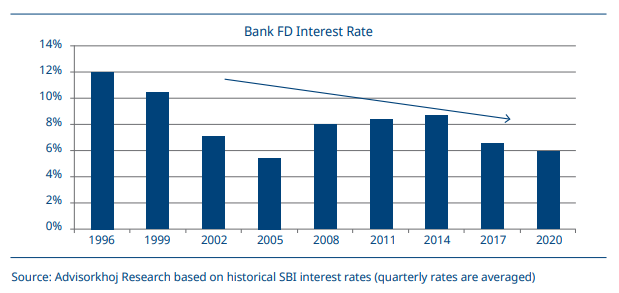
The image is a bar chart titled "Bank FD Interest Rate." It shows historical average bank fixed deposit interest rates for selected years between 1996 and 2020. The horizontal axis lists the years 1996, 1999, 2002, 2005, 2008, 2011, 2014, 2017, and 2020, while the vertical axis shows interest rates from 0% to 14%. The chart indicates an overall downward trend in fixed deposit interest rates over time. Interest rates were approximately 12% in 1996 and 10% in 1999, declining to around 7% in 2002 and 5% in 2005. Rates increased again to about 8% in 2008, 8.3% in 2011, and 8.8% in 2014 before falling to approximately 6.4% in 2017 and 5.9% in 2020. A diagonal arrow across the chart highlights the long-term decline in interest rates despite periods of temporary increases. The chart illustrates that bank fixed deposit interest rates have generally decreased over the years, meaning investors have earned lower interest on fixed deposits in recent years compared to the late 1990s. Source: Advisorkhoj Research based on historical SBI interest rates, with quarterly rates averaged.
Similarly, Government (Post Office) small savings schemes’ interest rates are also on a declining trend over the last 20 years from 12% to around 7% in 2020.
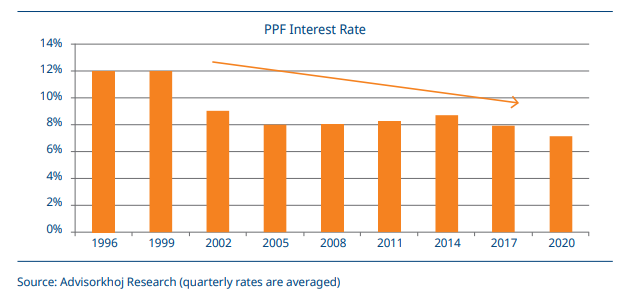
The image is a bar chart titled "PPF Interest Rate." It shows historical Public Provident Fund (PPF) interest rates for selected years between 1996 and 2020. The horizontal axis lists the years 1996, 1999, 2002, 2005, 2008, 2011, 2014, 2017, and 2020, while the vertical axis shows interest rates ranging from 0% to 14%. The chart shows that PPF interest rates were approximately 12% in both 1996 and 1999. Rates then declined to about 9% in 2002 and 8% in 2005. Between 2008 and 2017, interest rates remained relatively stable, fluctuating around 8% to 8.7%, before declining to approximately 7.1% in 2020. A downward-sloping arrow across the chart highlights the overall long-term decline in PPF interest rates despite periods of stability. The chart illustrates that PPF returns have generally decreased over the years, resulting in lower interest earnings for investors compared to the higher rates available during the late 1990s. Source: Advisorkhoj Research, based on quarterly rates averaged.
The Government has already announced cut in interest rates of small savings schemes. In the long term also, we may see further decline in interest rates as inflation goes down in our economy.
An Investor Education and Awareness Initiative by Mirae Asset Mutual Fund. All Mutual Fund investors have to go through a one-time KYC (Know Your Customer) including the process for change in address, Phone number, bank details, etc. Investors should deal only with registered Mutual Funds details of which can be verified on SEBI website (https://www.sebi.gov.in) under ‘Intermediaries /Market Infrastructure Institutions’. For further information on KYC, RMFs and procedure to lodge a complaint in case of any grievance, you may refer the Knowledge Centre section available on the website of Mirae Asset Mutual Fund. Investors may lodge complaints on https://www.scores.gov.in against registered intermediaries if they are unsatisfied with the responses. SCORES facilitate you to lodge your complaint online with SEBI and subsequently view its status.
Mutual Fund investments are subject to market risks, read all scheme related documents carefully.

 ETF Website